Showing posts with label thinkers. Show all posts

Saturday, October 10, 2015

 Can you recollect?-
The last time you had to struggle enormously?
 A time when you barely finished your project, assignment and were left with nothing but exhaustion, frustration and unhappiness.
A time when you thought, “This is it. I can’t do it anymore.”
I bet you can. In fact, I bet you can think of more than one such incident.
Why is this?
Even though we all want to run, or even gallop towards success, often when we think about some of the greatest moments in our lives, it’s not success that we recollect, it our failures, our weaknesses and our breakdowns.  Does this mean that we are a breed of thoroughly pessimistic and masochistic people who give more weightage to failures than accomplishments? Maybe… Maybe not!  But if we do, there is absolutely nothing wrong with it. Because these are the moments when we decided not to back down, to learn and to grow. Even though we might have struggled at one point of time, we overcame our hurdles and can now look back and feel satisfied, maybe even surprised at the way we conquered our impediments.
One of the greatest authors of our time and a personal favourite of mine, J.K Rowling gave the following words of wisdom at the Annual Meeting of the Harvard Alumni Association:

“You might never fail on the scale I did, but some failure in life is inevitable. It is impossible to live without failing at something, unless you live so cautiously that you might as well not have lived at all – in which case, you fail by default.”

When one hears her name, one cannot possibly fathom her ever failing at something. After all she is United Kingdom's best-selling author, with sales in excess of £238m. But in her own words, she has experienced failure at a, ‘grand scale’. 
Before, Harry Potter became a household name, Rowling was penniless, recently divorced, and raising a child on her own, she wrote the first Harry Potter book on an old manual typewriter. Not one, or three or five but twelve publishers rejected her manuscript. Eventually, Barry Cunningham from Bloomsbury, agreed to publish the book but advised her to find another job as, ‘there was no money in children’s books’.  
Rowling’s success came after her various bouts with failure and she wasn’t the only one.

The King of Cartoons: Walt Disney’s first animation company went bankrupt. A newspaper editor fired him for, ‘lacking imagination’ and ‘having no original ideas’. His theme park idea was trashed 302 times. But he never gave up.

Vincent Van Gogh: He only sold one painting in his lifetime that too, to a friend. In spite of that he kept painting and finished over 800 pieces. Today, his most expensive painting is valued at $142.7 million.
Michael Jordan: One of the world’s greatest basketball players, Jordan’s name is synonymous with basketball. However, he was cut from his high school basketball team but he did not let this failure deter him.
Thomas Edison: This list would be incomplete without the man who gave us many inventions including the light bulb. He too, never ever gave up.
Ludwig van Beethoven: Young Beethoven wasn’t good at playing the violin and neglected to practice as he preferred to work on his own compositions. Despite his love of composing, his teachers felt he was hopeless and would never succeed with the violin or in composing. Beethoven kept plugging along, and composed some of the best symphonies of all time–five of them while he was completely deaf.
As is evident from the above list, failure hits us all. The more we try to avoid it, the more it latches onto us like a parasite draining us of our strength, enthusiasm and happiness. The fault however, may lie within us. We are always trying to dodge failure, elude and escape it. But for once, try and embrace it. When you stumble upon failure, or make a mistake, it’s imperative to accept it and understand that it is absolutely acceptable to fail. Don’t make your mistakes, ‘an end of my life tragic melodrama’. Acknowledge that you did not succeed this time and that it is perfectly alright. Do not let the people or the situation around you make you feel dejected and unhappy.
Part of accepting failure is also accepting that you may be at fault. Do not pin your failures on, ‘fate’, ‘circumstances’, other people or the almighty. He has enough things to take care of and does not have the time to ensure that you fail in every undertaking that you take. Instead of accusing and attributing your failure to any and everything else, take a step back. Try to analyse why you did not accomplish your goal and where you might have gone wrong.

Do not relinquish at this stage. You might feel desolate and depressed. After all it is not easy accepting one’s own faults or perhaps finding faults where there aren’t any, (as in the case of Rowling). But Do Not Give Up. Find the courage to move on. Find a reason to move on. What’s more, you don’t have to do this alone. Ask for help. It maybe for ideas, other’s views and opinions or simply for emotional support from friends and family. Don’t shun your helpers.
Once you find the reason to move ahead (and you will find it), re-evaluate your objectives. If they are still the same, great. If not, think clearly and deeply about what exactly you want. Easier said than done. However, if you stay true to yourself you will discover it.
After you find your goal, plan, and plan well. Your previous failures and mistakes have already cut your work short. They have taught you the right from the wrong, what exactly to avoid, helped you gain a deeper understanding and provided you with the knowledge that you seek. But most importantly, if you are at this step, your failures have taught you to be resilient and given you an opportunity to grow and learn some more. They have given you the power to be a fighter and a survivor. Use it well.
Follow through your plan, soar above all the obstacles because now you are ready to run and bolt towards your success.  Always remember that failure and success are two sides of the same coin.  In life’s toss you can never predict which side the coin will land on. Don’t let a series of successes fool you. Always be prepared to taste some disappointments and at the same time remember to not give up and face the challenges head on. It’s really one of those simple truths of life: To succeed, you must fail.
So next time when you find yourself on a cliff overlooking a sea of disasters, mistakes and failures, here’s what you should do.
Close your eyes, take a deep breath and JUMP.


Saturday, October 3, 2015

Continuously Challenge yourself!- By Shruti Nair

This is not a motivational article that pumps you up to do great things. This is written just to show you the mere benefits of consciously challenging oneself. Of course we take up challenging tasks in our day-to-day lives, it comes naturally as we are working and ‘growing’ constantly. I am talking about the planned, defined, out-of-comfort zone scenarios that we create for ourselves. For example, taking up that job that does not compliment your strengths, rather demands you develop your weaknesses; planning a trip alone to a random place or leaving your paid job to fulfill your dream of becoming an artist.

I took up one such challenge of going on a trip alone for a week to the mountains. As the person that I am, before leaving I researched all about the place, the safety measures, experiences of other travellers but in all this, I forgot to really sit and introspect (research) about myself. Now, when I reached my destination, on day one, I visited the places I had planned for the day, ate at the restaurants I’d read about and returned to my room before dark. Around midnight I decided to sleep but I couldn’t switch off from my alert zone. Around half past midnight, I realised I won’t be able to sleep at all. The silence that existed in the room was piercing, one such I have never heard before. The kind of silence that I experienced there, brings negative emotions in you, it engulfs you in it. The three nights i spent there, I didn’t sleep for a minute.

In this trip, i saw beautiful places and made great friends but the highlight of my trip was learning something about myself. I always had trouble sleeping alone in a room. It’s not that I’m scared of ghosts, I just feel really insecure in sleeping alone. But when I returned from the trip, I can sleep anywhere, peacefully. This trip solved a problem I had, I never realised I needed to work on.

Therefore I suggest, take up challenges! You never know what you learn about yourself! Taking up challenges have many benefits:

1) You will get out of your comfort zone.
We, as humans, are conditioned to seek out comfort. Therefore it is difficult to let go of things; but letting go of things mean taking up new things, which will always lead to growth. What is the point in living the same routine life day after day? On my trip, I was thrown completely out of my comfort zone. I had to meet and talk to people, which is not my dominant nature. This made me realise I am the way I am by choice and if needed, I can adapt.

2) You will become more creative
When you take up challenges, you are basically figuring out solutions to different problems. This will force you to think out of the box, broaden your perspectives on things. You will also become more confident with 
your decisions and views on things. When you travel alone, you have to figure out everything on your own, from simple directions to dealing with language barriers. This allows you to approach problems in various different ways.

3) You will increase your strengths and work on your weaknesses.
When is something challenging to you? When you can’t do something naturally, easily, it becomes a challenge. Continuously taking up challenging tasks mean you work on your weaknesses and increase the list of strengths you posses. I was never good with handling money or saving. Travelling alone requires me to save up for these trips and manage money during trips. I’m not great at it but I’m better than what I was!

4) You will never be bored.
Regardless to say, when you take up challenges, you start working on yourself. Challenges remove the mundane nature that life easily falls into. A person who takes up challenges will never complain of a boring 
routine life. My journeys are what I look forward to and they also account for great conversation starters with people meet!

For me, going solo travelling is the way of challenging myself. How are you going to continuously challenge yourself?

Saturday, September 19, 2015

ANALYSING ROOT EMOTIONS - By Shohrat Shankar


Types of Human Expressions
Emotional Intelligence is based on the principle of Emotional Awareness, along with others.
Being aware of one’s own emotions is critical for just about everything. From your Self Esteem to relations with others and your success and progress. In fact your happiness depends on how aware you are of your emotions. On how much you know and truly understand why you feel the way you feel.

In this article I plan to illustrate how Emotional Awareness impacts your Self Regard, Self-Actualization and thus everything else in your life.
Over the years I have conducted numerous workshops on “Relationship Management” where I have a short section on Emotional Awareness and many of my observations are from there.

Positive & Negative Emotions

Positive & Negative Facial ExpressionsI normally start the session with asking people to list some emotions. Before they start I ask for some examples and in 8 cases out of 10 I hear ‘Anger’ or ‘Fear’ being said first.

Most people are not able to list beyond 8 emotions. The most common ones are: Anger, Sadness, Fear, Happiness, Love, Joy, Frustration, irritation and Jealousy.

One thing I notice every time is that we tend to list more negative emotions than positive, sadly often “Love” comes in way down on the list. I often wonder why it is so and on delving further and asking people I found that people tend to register the negative emotions they feel while mostly ignoring the positive feelings in the day. 

Reactions of facesYou might have noticed, when you asked somebody how their day went you will either hear a neutral response “OK” or if somebody had a bad day then they will say it. The percentage of people who say they’ve had a ‘great day’ is relatively smaller, in fact it takes a major positive event for most people to say they had a “Great Day”, on the other hand, it doesn’t take much for people to label the day “Bad”. Is it true that most of our days are either “Bad” or “OK” and very few “Great”? Or is it more likely that we tend not to register the small positive emotions that we feel in a day?

Positive Thought
So 2 important factors to remember are:

• “Am I focusing on enough positive things around me or only the negative emotions?”

• “Do I register the small-small nice things or positives that people do or do I fixate on the few things that they did not do?”

The answer to these questions tells me whether I look for Happiness and positivity in whatever I do. It tells me whether I am a happiness magnet or not.

Root Emotions

The second thought I drive is the need to understand and analyse the real reason or cause for my emotion. Similar to doing a root cause analysis in, it is often important to do the same for our behaviour and emotions. Let me try and illustrate with an example.

Let’s say that in a meeting with my colleagues and boss a task is assigned to me and immediately a colleague of mine asks if I need any help. Citing an example where I had failed in a situation when I had done it on my own.

Now many people here would be happy and graciously accept or decline the offer. However, some people would get upset and feel there was an underlying reason for the colleague to offer support in front of the boss.
Root cause
Some might feel he was doing it to appear like a good team player in front of the boss and others might think he wanted to put me down in front of the others. 
The important thing for me to analyse is “Why” or “What” is making me feel that way? What is the real reason for the reaction?

In order to understand my root or real reason for reacting I need to look at the following A-B-C-C model.

A – Activating event (Colleague offers to help)
B – Belief (He’s trying to put me down, He’s trying to show his competence over mine in front of the boss)
C – Consequence (I react and get upset either in the meeting room or later start to distance myself from the colleague)
C – Challenge 
In order for me to change the Consequence I need to Challenge & Understand my beliefs and the cause for my belief.

Challenge & Understanding
When challenging I need to ask myself, Am I sure he is trying to put me down? Does he do this often? Does he also sometimes just willingly offer his hand in assistance? Have I seen him doing this with others?

The answers to these questions will help one rationalise the beliefs and one might realise that probably he could really want to help.
Then it is important to understand the reason for your beliefs. Is it that you really feel scared of doing this task alone? Do you doubt your own competency in fulfilling this task? Do you feel that the colleague is really more competent than you? 

Often we are unwilling to accept the reality of the answers to the above questions and unless we dig deep to understand and accept the reality we might never be able to understand our real emotions and will never be able to challenge the beliefs that cause us to react.
So understand the real reason for the Belief to know why you feel the way you feel and thus react the way you react.


Saturday, September 5, 2015

TO MA’AM, WITH LOVE - By Latika Kaul


“Friends, Romans, countrymen, lend me your ears;
I come to bury Caesar, not to praise him.
The evil that men do lives after them;
The good is oft interred with their bones;
So let it be with Caesar.”

 Act III, Scene II, Julius Caesar by William Shakespeare

To this day, I get goose bumps when I hear or read these lines. The credit for this goes to a strong, dignified and fierce woman who commanded attention from the moment she entered a class. Mrs. Lakshmi Menon.

 The very first memory that I have of her is of terror as she screamed at our class for making noise during a free period. Fast forward to standard IX, she became our English teacher. And then everything changed. I changed. The fear disappeared, all that was left was immense amazement, respect and gratitude.

She taught us with such passion, fervour and enthusiasm that in every class we were transported to different worlds. She introduced us to Saki, Wodehouse, Frost, O. Henry, Keats, Tennyson, R. K Narayan and many more extraordinary writers and poets. She didn’t just teach us their stories and poems, she breathed life into them. She talked about the author’s lives and what must have led them to write their masterpieces.

And then there was Shakespeare. These were the classes I think everyone enjoyed the most. Julius Caesar was like a roller coaster ride with all its ups and downs. We hated Caesar for his arrogance and yet were left agonized over his brutal death. We initially looked up to Brutus, then despised him for scheming with Cassius and eventually pitied him for his nobility. Marc Antony, however, was a favorite amongst us all.
The defining moment that not only changed the plot in Shakespeare’s play but also in my life was Anthony’s funeral speech. It wouldn’t be wrong to say that Mrs. Menon was as good an orator as Shakespeare wrote Anthony to be.  


She not only taught us their stories but always inspired us to write our own. We were no longer kids who wrote boring essays, she saw us as adults who were capable and allowed to write romances, thrillers, horrors or the simple truths of our lives. Due to her encouragement many students began to write and share their work, including me. She always appreciated us, as well as helped us identify ways we could write better. For me, my first achievement in this field was when I received a 23 on 25 on my essay which was a story. Contrary to this, I got a zero in my letter writing for three term exams for making minor mistakes like adding an apostrophe, ‘s’ in, ‘yours’ or missing a comma somewhere. But thanks, to this I now know how to write a perfect formal letter. Before her classes I was not even remotely interested in reading, but like many other things, this too, changed. The very first book I read (in the actual sense of the word) was, ‘The Ambler Warning’ by Robert Ludlum and after that there was no turning back. 

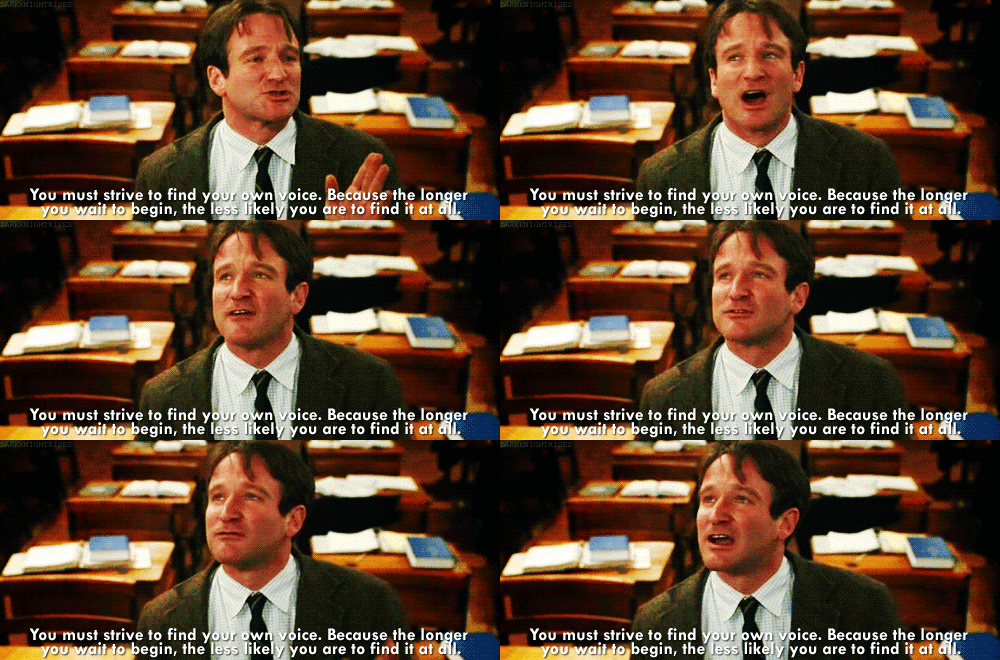
One of my all-time favourite movie genres is of films depicting teacher- student relationships. Films like, Freedom Writers, Remember the Titans, Lean on me, Dead Poets Society and even Sister Act. These are films I can watch over and over again. As I was writing this article, I realized why I love these kind of films. It’s simply because I can relate to it. In all these films, the protagonist who is a teacher or a coach changes the lives of his or her students in ways that were unfathomable before. You might say that this only happens in films but I can assure you, it happens in real life too and I have experienced it first-hand. I have also heard people complain that gone are the days when teaching actually meant something, days when teachers whole-heartedly took interest in their student’s lives or even bothered to take interest in their subject.


While this could be true, let’s not forget that students on their part hardly remember, appreciate or respect their teachers.

The ultimate fact, however is that teachers have always been and will always be an integral part of any student’s life.


So, to all the teachers, I wish you a very happy teacher’s day and I hope that you realize what an immensely honorable responsibility it is to be a teacher. May you continue to mould impressionable minds and light the way for the future generations.